Hiragana and katakana chart with romaji
Japanese is written with two sets of sound letters, hiragana and katakana, together with kanji. Each kana stands for one sound, so once you know these two charts you can read anything written in kana. Below are all 104 sounds of each set: the 46 basic sounds, the 25 voiced sounds and the 33 combinations, with romaji in the Hepburn system (shi, chi, tsu, fu).
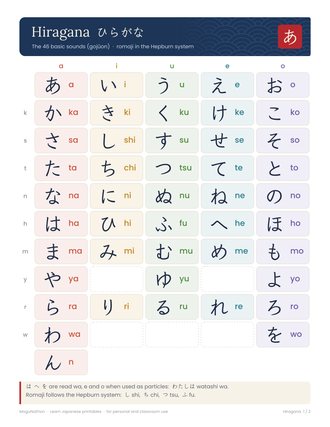
Printable charts in US Letter, A4 and 18 x 24 in posters, in color and an ink-saving black and white version.
Get the printable charts on EtsyHow to read the chart
Read each row from left to right: a, i, u, e, o. The letter at the start of the row is the consonant, so the k row is ka, ki, ku, ke, ko. A few sounds do not follow the pattern exactly: し is shi, ち is chi, つ is tsu and ふ is fu. ん, the only kana that is a consonant on its own, is read n.
Hiragana: the 46 basic sounds ひらがな
| a | i | u | e | o | |
|---|---|---|---|---|---|
| あa | いi | うu | えe | おo | |
| k | かka | きki | くku | けke | こko |
| s | さsa | しshi | すsu | せse | そso |
| t | たta | ちchi | つtsu | てte | とto |
| n | なna | にni | ぬnu | ねne | のno |
| h | はha | ひhi | ふfu | へhe | ほho |
| m | まma | みmi | むmu | めme | もmo |
| y | やya | ゆyu | よyo | ||
| r | らra | りri | るru | れre | ろro |
| w | わwa | をwo | |||
| んn |
Hiragana: voiced sounds
Two small marks change the sound: ゛ (dakuten) and ゜ (handakuten), as in か → が, は → ぱ.
| a | i | u | e | o | |
|---|---|---|---|---|---|
| g | がga | ぎgi | ぐgu | げge | ごgo |
| z | ざza | じji | ずzu | ぜze | ぞzo |
| d | だda | ぢji | づzu | でde | どdo |
| b | ばba | びbi | ぶbu | べbe | ぼbo |
| p | ぱpa | ぴpi | ぷpu | ぺpe | ぽpo |
Hiragana: combinations
A kana from the i column followed by a small ya, yu or yo makes one sound (yōon): き + ゃ → きゃ (kya).
| ya | yu | yo | |
|---|---|---|---|
| ky | きゃkya | きゅkyu | きょkyo |
| sh | しゃsha | しゅshu | しょsho |
| ch | ちゃcha | ちゅchu | ちょcho |
| ny | にゃnya | にゅnyu | にょnyo |
| hy | ひゃhya | ひゅhyu | ひょhyo |
| my | みゃmya | みゅmyu | みょmyo |
| ry | りゃrya | りゅryu | りょryo |
| gy | ぎゃgya | ぎゅgyu | ぎょgyo |
| j | じゃja | じゅju | じょjo |
| by | びゃbya | びゅbyu | びょbyo |
| py | ぴゃpya | ぴゅpyu | ぴょpyo |
Katakana: the 46 basic sounds カタカナ
| a | i | u | e | o | |
|---|---|---|---|---|---|
| アa | イi | ウu | エe | オo | |
| k | カka | キki | クku | ケke | コko |
| s | サsa | シshi | スsu | セse | ソso |
| t | タta | チchi | ツtsu | テte | トto |
| n | ナna | ニni | ヌnu | ネne | ノno |
| h | ハha | ヒhi | フfu | ヘhe | ホho |
| m | マma | ミmi | ムmu | メme | モmo |
| y | ヤya | ユyu | ヨyo | ||
| r | ラra | リri | ルru | レre | ロro |
| w | ワwa | ヲwo | |||
| ンn |
Katakana: voiced sounds
Two small marks change the sound: ゛ (dakuten) and ゜ (handakuten), as in カ → ガ, ハ → パ.
| a | i | u | e | o | |
|---|---|---|---|---|---|
| g | ガga | ギgi | グgu | ゲge | ゴgo |
| z | ザza | ジji | ズzu | ゼze | ゾzo |
| d | ダda | ヂji | ヅzu | デde | ドdo |
| b | バba | ビbi | ブbu | ベbe | ボbo |
| p | パpa | ピpi | プpu | ペpe | ポpo |
Katakana: combinations
A kana from the i column followed by a small ya, yu or yo makes one sound (yōon): キ + ャ → キャ (kya).
| ya | yu | yo | |
|---|---|---|---|
| ky | キャkya | キュkyu | キョkyo |
| sh | シャsha | シュshu | ショsho |
| ch | チャcha | チュchu | チョcho |
| ny | ニャnya | ニュnyu | ニョnyo |
| hy | ヒャhya | ヒュhyu | ヒョhyo |
| my | ミャmya | ミュmyu | ミョmyo |
| ry | リャrya | リュryu | リョryo |
| gy | ギャgya | ギュgyu | ギョgyo |
| j | ジャja | ジュju | ジョjo |
| by | ビャbya | ビュbyu | ビョbyo |
| py | ピャpya | ピュpyu | ピョpyo |
Things that trip up beginners
- は, へ and を are read wa, e and o when they are particles: わたしは watashi wa.
- A small っ doubles the next consonant: きって kitte (stamp). In katakana it is ッ: チケット chiketto (ticket).
- Long vowels are written with an extra kana in hiragana, おかあさん okāsan (mother), and with a bar in katakana, コーヒー kōhī (coffee).
- ぢ and づ sound like じ and ず, and are rarely used.
- Watch the katakana look-alikes シ shi and ツ tsu, ソ so and ン n. In シ and ン the long stroke goes up from the bottom; in ツ and ソ it comes down from the top.
- Katakana adds sounds for foreign words: ファ fa, ティ ti, ウィ wi, シェ she, ヴ vu and more.
Which comes first?
Most learners start with hiragana. It is used for grammar endings and for words written without kanji, and children’s books are written in it. Katakana is used for words from other languages and for foreign names, such as アメリカ Amerika. After the kana, the next step is kanji: the 103 kanji of JLPT N5 are a good place to start.